Licensed & Insured | Serving Taunton, MA
Friendly local septic care from a crew that picks up the phone, shows up when promised, and finishes the job clean. Call Monday through Saturday, 8am to 6pm.
Routine care, careful inspections, and honest repairs. We treat your system like it belongs to a neighbor, because around here, it often does.
A timely pump-out keeps solids out of your leach field and adds years to the life of your system. We remove every bit of buildup, then leave the area tidy.
Learn more →Buying a home, selling one, or just want to know where you stand? We walk every part of the system and give you a plain-language report you can actually use.
Learn more →Broken baffle, tired pump, soggy leach field, we figure out the real cause first and fix only what needs fixing. No guesswork, no padded estimates.
Learn more →We earn our reputation one driveway at a time. Show up on time, do honest work, leave the yard the way we found it. That's the whole plan.
Open Monday through Saturday, 8am to 6pm. Give us a ring and we'll find a slot that fits your week.
Family owned and based right in Bristol County. The person who answers the phone is also the person on the truck.
Fully licensed and insured under Massachusetts Title 5. Your property and our crew are both protected.
Same-day appointments are often available. Call early and we'll do our best to be at your home by afternoon.
Booking a septic visit shouldn't feel harder than the actual work. Here's how a typical job flows from your first call to the moment we pack up.
Calling is the quickest way to reach us. Prefer to type? Use the online form. Either way, you'll hear back with a real price and an open time slot, no runaround.
Your day already has enough on it. We work around your calendar and offer same-day slots when something feels urgent. You won't sit waiting for a four-hour window.
Our truck arrives when promised, our crew works cleanly, and we walk you through what we saw before we leave. No surprise charges, no muddy lawn, no repeat visits for the same problem.

If your house is not connected to a sewer system, all the wastewater that enters a drain heads to a buried tank somewhere in your yard. That tank gives solid material time to settle and lets helpful bacteria break things down. Once that happens, the cleaner liquid moves out to a drain field, where the soil finishes the work.
Septic pumping means removing the built-up material that accumulates inside the tank year after year. Three distinct layers form in there. The heaviest waste settles to the bottom and turns into sludge. Lighter substances like grease and soap float to the surface and create a scum cap on top. The clear liquid in the middle, called effluent, drains out toward your leach field. As the two outer layers grow, the middle layer shrinks. Wait too long and solids start slipping into the field lines, where they don't belong. That's when a small job turns into a five-figure repair.
Cleaning goes one step further than pumping. Many companies vacuum out the easy liquid and leave the packed sludge behind. We don't. Our crew breaks up the bottom layer and removes it completely, so the tank starts fresh and your drain field gets a real break.
If you've never seen your tank lids, no worries. We'll help you locate them on the first visit. Raising the lids with risers brings them up to grade level and saves you digging time on every future appointment.
The honest answer is "it depends," but for an average household with a 1,000 to 1,500 gallon tank, three to five years is the sweet spot. That guidance comes from Penn State Extension and the EPA for an average home. Household size matters most. One adult couple fills a tank slowly, while a family of six can pack the same tank in half the time. Tank size and garbage disposal use both play a part. Research from Virginia Tech shows a disposal can roughly double the solids going into a tank.
Not sure when the tank was last serviced? That alone is reason enough to book a visit. When we arrive, we'll measure your sludge depth and set a target interval that fits your household. Putting off a pump-out to save a few hundred dollars usually backfires, since a clogged drain field pushes the bill from routine service all the way up to a full drain field replacement.
Septic systems rarely fail without warning. Catch the signs early and you keep your choices. Wait, and the system decides for you. Here are the cues homeowners spot most often.
Spot any of these? Pick up the phone. An early call almost always means a smaller repair and a smaller bill.
A pump-out is calmer than people picture. You don't need to do anything beyond pointing toward the tank if you know where it is and clearing any obstacles around the lid.
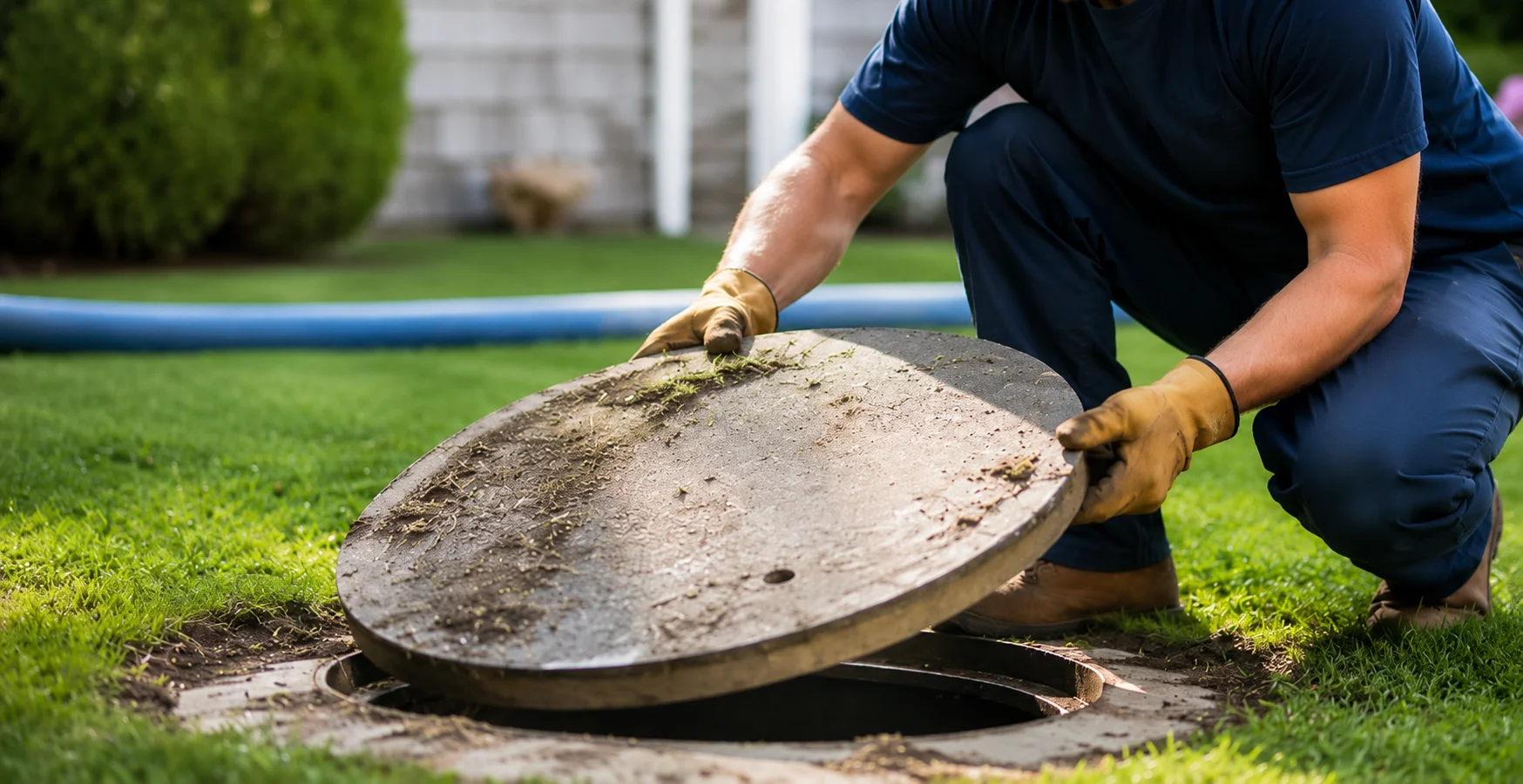
When the truck pulls in, our technician finds the access ports and opens them. A heavy-duty vacuum hose drops into the tank and we draw out the scum, the effluent, and the bottom sludge in one continuous job. With the tank empty, we check the walls for cracks, inspect the inlet and outlet baffles, and confirm the tees that direct flow are still in place. A failed baffle is one of the quickest ways for solids to slip into your field lines, so catching it now beats finding out the hard way.
Before we leave, we walk you through what we found and answer any questions in plain words. No upsells, no fear tactics. If the tank looks great, we'll say so. If something needs a closer look, you'll get the straight story with real options.
Reading this from another corner of Massachusetts? Septic systems work the same everywhere, and so does good service. Homeowners in Southern California's Inland Empire can turn to Jurupa Valley Septic Pros for Septic Tank Service in Riverside County.
How you treat your system between pump-outs decides how long it lasts. A few simple habits can add many years to the tank and field.
Monitor your water use. A septic tank needs quiet time to settle. Large back-to-back loads push solids out before they've settled. Run laundry on separate days, fix leaky faucets, and replace any silently running toilets.
Be choosy about what you send down the toilet. The bacteria in your tank only break down a short list of things. Wipes labeled flushable, paper towels, cotton products, floss, old medication, and chemical cleaners all cause trouble. Natural waste and toilet paper only, please.
Mind the kitchen sink and protect the drain field. Scrape grease off pans before you rinse them. Keep cars and heavy equipment off the field, skip shrubs and trees nearby (the roots will find your pipes), and route gutters and sump pumps somewhere else so the soil can keep filtering wastewater.
Skip the backup, skip the surprise bill. A short phone call today keeps a small problem from turning into a large one.
Our shop is right here in Taunton, and our crews stay close to home, serving the same neighborhoods they live in. Whether we're working a narrow residential driveway or one of the long dirt roads out past the cranberry bogs, we've got the right-sized trucks and the patience to handle the job.
Most of our work happens across Bristol County and the towns just outside it, including Raynham, Norton, Easton, Mansfield, Bridgewater, Dighton, Berkley, Rehoboth, Seekonk, and Attleboro. Plenty of nearby towns aren't on that list, so reach out anyway. We travel based on need and availability, and we're glad to help anyone across southeastern Massachusetts.
Got an urgent backup? Call no matter where you live. We can't promise an exact response time, since schedules vary, but we'll make every effort to reach you as fast as we can.
Short, direct answers to the questions homeowners ask us most.
Have a question we didn't cover?
Call us at (774) 504-6773Routine septic care is one of the smartest dollars a homeowner spends. Call us for a pump-out, a free quote, or just to ask a question about your system. We're happy to chat.
